Your House Help Knows Everything. Could You Survive One Monday Without Them?
In many Nigerian homes, one person keeps the entire household running. What happens when they take a day off?
They know where Daddy's belt is, which child refuses vegetables, and which pot must never be used for boiling water. They know when the generator needs fuel, where Mummy keeps the good plates, and why Sunday's rice must be ready even when church closes at 1:30 p.m. instead of the advertised 11 a.m. They also know that the relative who is “just passing through” will probably stay for three weeks.
In many homes, the person who knows the family best is not sitting at the head of the table. They are in the kitchen, quietly managing an operation nobody else seems qualified to run. So, here is the question nobody asks over breakfast: what happens when your house help does not show up on Monday?
Monday Morning, Zero Help. Picture it. Monday arrives, and nobody is coming.
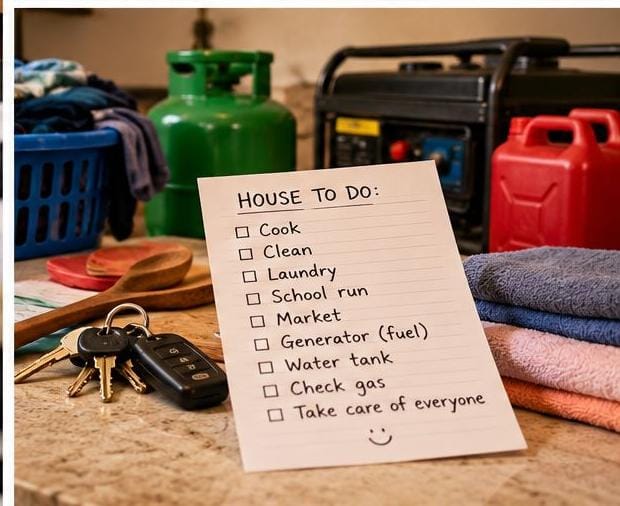
• 5:45 a.m. NEPA takes the light. The generator needs fuel, nobody knows where the jerrycan is, and the borehole pump cannot fill the tank. The tank is almost empty, naturally.
• 6:30 a.m. The kitchen is suspiciously quiet. Breakfast does not exist. Somebody opens the fridge for the fourth time, hoping food has magically appeared.
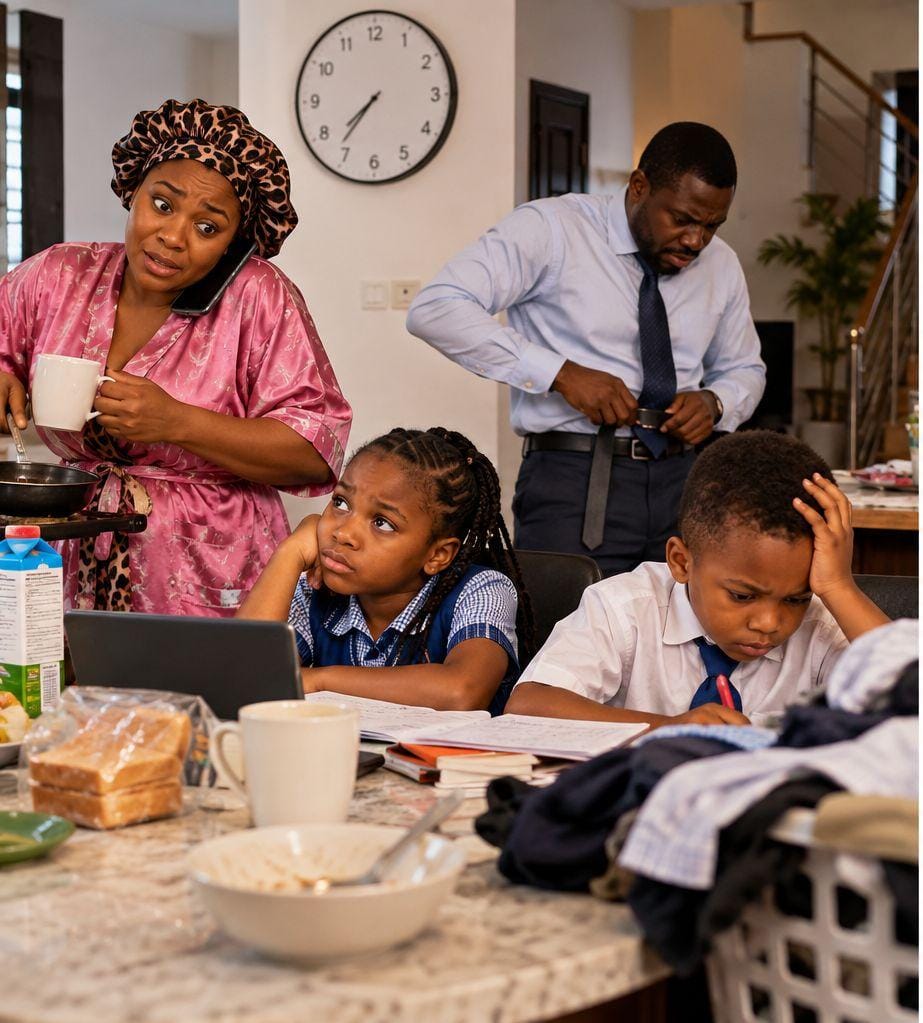
• 7:00 a.m. One child cannot find a uniform. Another has just remembered a school project due today. It requires cardboard, glue and the patience of a saint.
• 7:40 a.m. Daddy is hunting for his belt. Mummy is wondering whether the gas cylinder is full or else merely giving false hope.
• 8:15 a.m. The laundry is still in the basket, the sink is full, Lagos traffic has started its daily nonsense, and you have a 9 a.m. meeting.
Somebody finally shouts, “Abeg, who knows where the generator key is?” Silence. The person who knows is not home. Suddenly, the household is an emergency response team without a coordinator. Nobody has eaten, the children are late, and your meeting is about to become an audio-only affair. You have not even had breakfast, and somehow Monday has already defeated you.
Needing Help Is Not the Problem. Let's get one thing straight: nobody is here to shame you for hiring help. For many Nigerian families, domestic support is a practical answer to demanding jobs, long commutes, young children, elderly relatives, and the sheer volume of work it takes to keep a home running. Nobody should have to finish an eight-hour workday, battle Lagos traffic for another two hours, and return home for a second shift of cooking, cleaning and laundry. Nigerian homes have extra departments to manage: generator fuel, borehole water, market runs, school runs and visitors who arrive without notice.
At this point, the household needs an operations manual. Some families employ cleaners who visit twice a week. Others have cooks, nannies or else live-in helpers. Plenty manage without paid help by sharing responsibilities between adults and children. There is no single arrangement that works for everyone. The trouble starts when domestic help becomes a substitute for planning and shared responsibility. If nobody else in the house can prepare a simple meal, manage the children's routine or else find important documents, the problem is not the absence of help. It is the household's dependence on one person. That is a different wahala entirely.
The House Runs on One Person's Memory. There is a special kind of confidence that comes from having someone who knows your home inside out. You do not need to remember where the extra towels are, which tomato seller gives the real price, or else which switch controls the borehole pump. Someone already knows. You can tell a visitor, “Make yourself comfortable,” because somebody else has made the house comfortable. That is how domestic workers become the unofficial control room of the household. They know everyone's routines, preferences and habits. Sometimes, they know you are about to have a difficult day before you do. But knowing a household is not the same as being responsible for every part of it. When all the household knowledge lives in one person's head, your home becomes a one-person show with no understudy. That is not a system, it is a risk wearing house slippers.
“You're Like Family” Deserves a Second Look
We love to say domestic workers are part of the family. Sometimes, they genuinely are. They may care deeply about the children, celebrate family milestones and stay for years. But the phrase can also do some heavy lifting. If someone is truly treated like family, do they receive fair pay, reasonable hours, proper rest, privacy and respect? Or does “you're like family” become an excuse for asking them to work beyond their agreed duties? Does their salary arrive on the agreed date, or else does the alert show up with the same reliability as NEPA? Were their pay, hours and days off clearly agreed, or else did the arrangement begin with “we will see how it goes”? And if your help lives in, remember that the workplace is also their home. Closing time should not disappear simply because they live under your roof. Warmth is lovely. It is not a salary, and it is definitely not a day off. Besides, “Abeg, just help me do small thing” can quickly become a second job. The small thing may come with three additional tasks and a pot of soup that needs constant stirring. Domestic workers have lives, families, ambitions and responsibilities outside the homes where they work. Their work deserves respect. A well-run household should depend on clear expectations, fair treatment and a realistic division of labour, not one person's exhaustion.
The One-Weekend Experiment
Here is a challenge worth trying: spend one weekend managing your household without relying on your usual domestic help. Choose a realistic weekend. Include the Saturday market run, the owambe outfit still waiting at the tailor's, Sunday's rice and the relative who “just dropped by”. Then ask yourself:
• Who cooks and washes the dishes?
• Who looks after the children?
• Who handles the market run and gets the real price?
• Who keeps the generator fuelled and the water tank full?
• Who remembers the shopping list?
• Who puts everything back where it belongs?
You might discover that your household works beautifully as a team. Congratulations. Please share your secret. Or you might discover that someone who has lived in the house for ten years does not know where the dustpan is. Either way, you will learn something useful about the work your household produces and who carries the greatest share of it. One important rule: do not use this experiment to deny anyone their agreed time off. Choose a weekend when your help is already off, or else simply run the exercise on paper. This is a test for your household, not a punishment for theirs.
So, Could You Run a Home Without Help? Absolutely. Plenty of people do. But the better question is whether your household can function without placing too much responsibility on one person. Domestic help can save time, reduce pressure and make daily life easier. There is nothing wrong with paying for support when you need it and can afford it. What matters is treating the person who provides that support fairly and making sure everyone else carries a reasonable share of the work.
The next time your house help takes a day off, try not to panic. Notice the work they normally do without being asked. Notice the small tasks that seem to happen by themselves. Because if your entire household collapses the moment one person takes a day off, you may not have a domestic help problem. You may have a household management problem.
Now, could your household survive one full week without domestic help? Would it be business as usual, or else would somebody suddenly discover that the washing machine has buttons and the generator does not start itself?