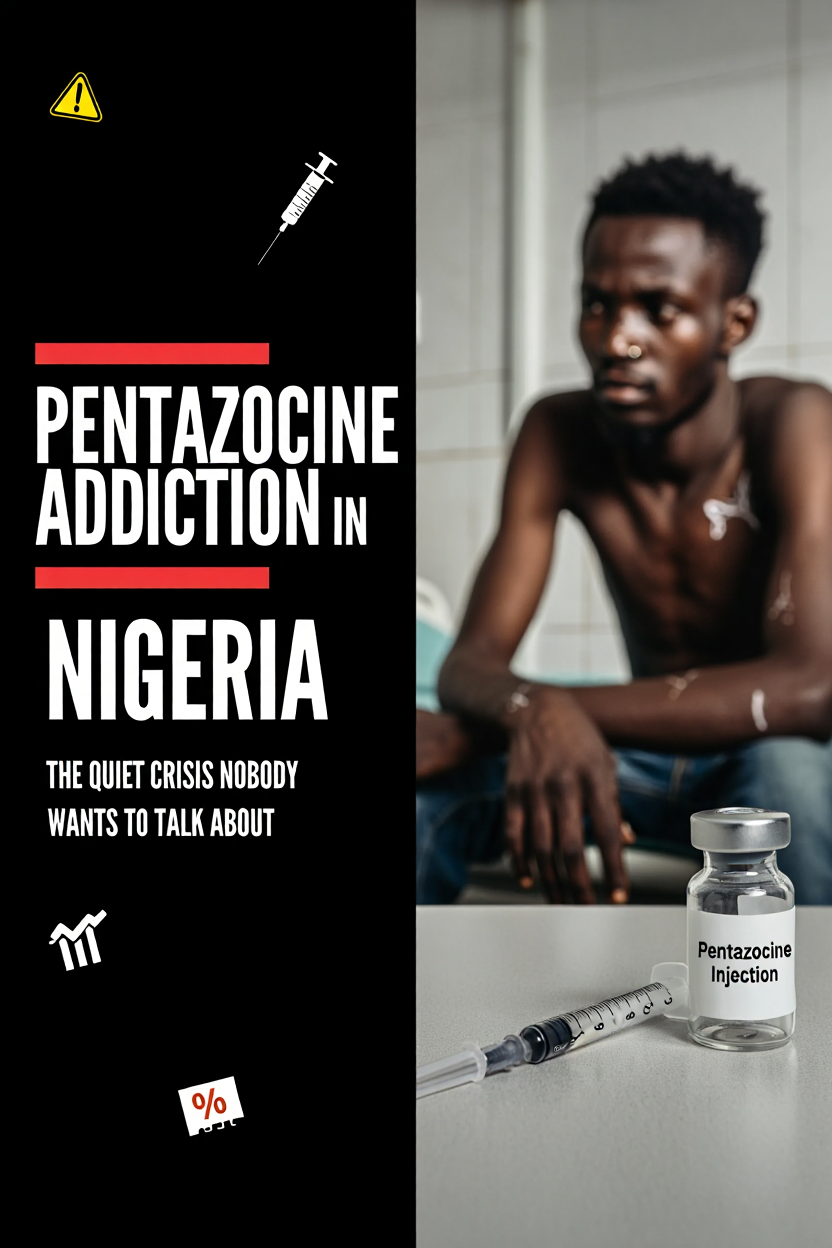
Pentazocine addiction in Nigeria: the quiet crisis nobody wants to talk about
Let&rsquos talk about something that doesn&rsquot get enough airtime in Nigeria&rsquos health conversations.
Not malaria. Not hypertension. Not even diabetes, it often starts in hospitals, not on the streets.
Pentazocine.
If you&rsquove never heard of it, good. That usually means it has not entered your personal story yet. But in some corners of our healthcare system, it has become one of those &ldquowe need to talk about this properly&rdquo issues, because what starts as pain relief sometimes slowly turns into something else entirely.
First things first, what even is Pentazocine?
Pentazocine is a painkiller. A strong one. It is used in hospitals to manage moderate to severe pain. This is not a bad drug, it has a medical purpose. In the right hands, for the right patient, it does its job. The problem is not its existence, the problem is what happens when pain relief becomes a repeated escape route instead of a controlled medical intervention, in Nigeria, that line sometimes gets blurry.
It usually doesn&rsquot start like a &ldquodrug problem&rdquo nobody wakes up and says, &ldquotoday I want to become dependent on an injectable opioid.&rdquo It starts with pain. Sickle cell crises, post-surgery recovery, accidents and other chronic pains.
At first, Pentazocine feels like relief. Proper relief. The kind that lets someone breathe again after days of discomfort, that is where the danger hides, because when something works that well, the brain remembers.
The injection factor changes everything Pentazocine is often given by injection, and injections are fast. Faster relief, faster sensation, faster &ldquoI feel better&rdquo. Over time, that speed starts to matter more than it should. What begins as &ldquodoctor prescribed this for pain&rdquo slowly turns into:
- &ldquoThis one works better than tablets&rdquo
- &ldquoTablets are not doing anything for me&rdquo
- &ldquoCan I just get the injection instead?&rdquo
And just like that, the mind starts learning preference, not for healing but for relief. When relief becomes a routine, the pattern becomes harder to ignore. In some cases, patients begin to:
- Request it more often than necessary
- Prefer injections even when oral medication would work
- Increase frequency without proper supervision
- Or worse, self-administer outside clinical settings
At this stage, it is no longer just pain management, it is repetition, and repetition, in medicine, is where dependence can quietly grow legs.
The part people don&rsquot see: it is often medical-born, this is the uncomfortable truth. A lot of Pentazocine dependence cases do not begin outside the healthcare system, They begin inside it Inside prescriptions, inside hospital wards, inside legitimate treatment plans. Society is used to thinking: &ldquoDrug addiction comes from bad choices on the street&rdquo, but here, the pathway can start with something as simple as: &ldquoTake this injection for your pain&rdquo, and no one really warns you about what repeated exposure over time can do to the body and the mind.
The body eventually starts paying attention, long-term misuse does not stay invisible forever.
The body begins to respond in ways that are hard to ignore:
- Skin and tissue damage at injection sites
- Repeated infections
- Visible wounds that refuse to heal properly
- General physical decline
At this point, the drug is no longer just about pain relief, it is about managing the consequences of previous use.
The emotional side nobody talks about enough, we always talk about addiction like it is purely physical, but there is an emotional layer too, because for many people, this starts with something very human:
&ldquoI just want the pain to stop so I can function like myself again&rdquo, So when dependence starts creeping in, it does not always feel like addiction, it feels like survival, and that is why judgment never helps in these conversations. It misses the point entirely.
A system question we cannot avoid
If we zoom out a bit, the question becomes bigger than individuals.
It becomes:
- How do we manage pain in our hospitals?
- How do we monitor long-term opioid exposure?
- How do we support patients after discharge?
- How do we detect early dependency before it escalates?
Because if pain is treated in isolation, without follow-up, without education, without structure, then the system is quietly setting up conditions for misuse, not intentionally, but still effectively.
The uncomfortable truth
Here is what most people don&rsquot want to say out loud, some of the most complicated drug dependency stories in Nigeria do not start in dark corners, they start in white rooms, clean hospitals, clinical instructions, legitimate prescriptions, and this is exactly why it is dangerous. Because nobody is watching for it early.
So what do we do with this information? Firstly, we stop pretending it is not happening, secondly, we start treating pain management as more than just &ldquogive medication and move on, and thirdly, we begin to understand that relief is not the same thing as resolution. Because if relief becomes the only goal, then anything that works fast can quietly become a risk even in healthcare settings.
Final thought
Pentazocine is not the villain here, neglect is. Lack of follow-up, poor pain education and silence around early dependency signs is. In healthcare, the most dangerous problems are not always loud and in your face, they are quietly consistent, until they are too big to ignore.
|