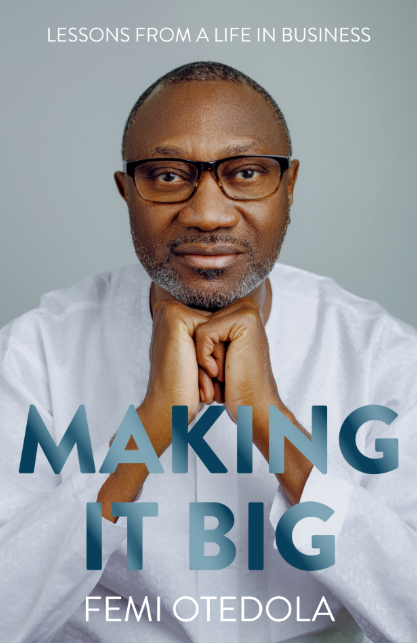
Making It Big is not a fairytale success story. It is a blunt account of how wealth, risk, timing, and institutional realities collide in the Nigerian business environment. Written by Femi Otedola, the book strips away the myth of effortless success and replaces it with something more uncomfortable: outcomes are shaped by both individual decisions and external systems that are often beyond control.
That said, it is important to be clear from the start. This is not a blueprint you can copy and expect identical results. The idea of replicating Otedola's journey is unrealistic. Different starting points, networks, timing, and exposure make that impossible. But what is transferable are the principles behind his decisions.
Three lessons stand out.
- Parenting, Exposure, and Early Formation One of the most surprising insights in the book is how unconventional Otedola's educational path was. He did not follow a neat academic trajectory. Instead, his development was shaped through informal learning, apprenticeship under his father, exposure to business environments, mentorship, and self-education.
What stands out is not the absence of formal education, but the presence of intentional guidance.
His parents did not treat his path as a failure to conform they actively supported his entrepreneurial direction. That support acted as a buffer against the limitations of formal schooling.
The lesson is not &ldquoschool is irrelevant.&rdquo The lesson is more precise: early support systems can either suppress or else amplify talent. The difference often determines how far that talent goes.
&ldquoWhen I started selling to individual homes out of the drum, my father was my first customer. I delivered ten 200-litre drums to his house&hellip&rdquo (p. 73)
At the same time, the book indirectly raises a warning: support without structure can create dependency. Encouragement must still be paired with discipline and skill-building.
- Debt: A Growth Tool That Can Also Break You One of the strongest themes in the book is leverage.
Otedola is clear about a hard truth: serious business expansion often requires debt. But he is equally clear about the danger of unmanaged leverage. Debt accelerates growth, but it also accelerates collapse when assumptions fail.
His experience with Zenon illustrates this sharply. Exposure to global oil price shocks, combined with weak risk controls, triggered a debt crisis that escalated to billions. By 2009, liabilities had ballooned to ?220 billion, later restructured through AMCON at a significant haircut.
This wasn't just a financial problem. It was a systems shock.
The important takeaway is not 'avoid debt.' It is 'respect debt.' Without discipline, debt stops being a tool and becomes a trap.
'Debt is like a chain around your neck it does not give you room to breathe.' (p. 192)
Another overlooked insight here is recovery structure. The involvement of banks in restructuring and the hiring of technically strong leadership shows that survival in crisis depends less on ego and more on accepting external expertise.
- Hiring Is a Scaling Strategy. A recurring point in the book is that entrepreneurship and company-building are not the same thing.
Starting a business requires vision. Scaling it requires management depth.
Otedola emphasizes that the turning points in his companies were not just market decisions, but people decisions. One standout example is his relationship with Akin Akinfemiwa, whom he credits as a transformational hire.
The underlying message is simple but often ignored: talent selection is a strategic advantage, not an administrative task.
Hiring mistakes are expensive. Hiring correctly can change the trajectory of an entire organization.
'My best recruitment ever: Akin Akinfemiwa, the CEO who helped turn Forte Oil into a world-class company.' (p. 49)
The deeper principle here is discipline in standards. Once non-negotiables like integrity and execution are defined, they must be enforced even when inconvenient.
Final Reflection: The Part Most People Avoid
What makes this book stand out is not just the business lessons, but the honesty about environment.
Otedola does not pretend that success happens in a vacuum. He openly acknowledges that structural inefficiencies especially in Nigeria's power sector created opportunities that shaped Zenon's growth.
That kind of transparency is rare in success narratives.
'Zenon reached the heights it did because the country was not functioning well&hellip' (p. 157)
This does not reduce his achievements. It contextualizes them. And that context is what makes the book valuable.
|