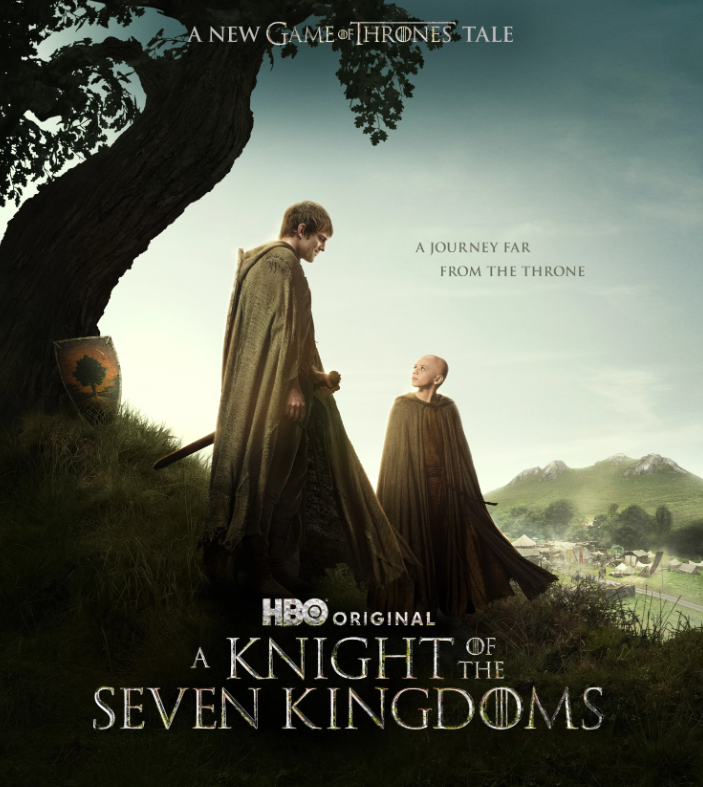
A Knight of the Seven kingdoms
In Westeros, titles usually decide everything: who lives, who gets heard, and who ultimately matters. A Knight of the Seven Kingdoms quietly challenges that idea by focusing on something far more uncomfortable&mdashthat identity is not granted by status, but revealed through what people choose to do when status is stripped away.
At the center of this story is Dunk, a tall hedge knight with almost nothing to his name: no wealth, no reputation, and barely even a legitimate claim to knighthood. What he does have is a belief, not in himself at first, but in the idea that knights are supposed to protect people, even when it costs them everything. That belief is tested immediately when Ser Arlan of Pennytree, the knight who raised him after saving him from the streets, dies on the road to Ashford. Arlan does not just leave Dunk a sword&mdashhe leaves him with a question that quietly defines the entire story: what does a knight do when the person who defined knighthood is gone?
Instead of turning back, Dunk steps forward and takes Arlan&rsquos place at a grand tournament he is clearly unprepared for, not out of ambition, but out of stubborn conviction that knighthood still means something if he can prove it through action.
Ashford: Venue of the Tourney
Ashford is overwhelming by design, a gathering of nobles, knights, merchants, and performers all competing for attention under the shadow of the castle, and Dunk immediately becomes someone the world struggles to even classify.
He cannot prove himself, yet he refuses to stop trying. Even as he is dismissed and doubted at every turn, he continues to act according to the idea of knighthood rather than its recognition. It is here that he meets Egg, a strange bald boy who first appears as a stablehand but quickly proves to be far more perceptive than expected. Egg does not challenge Dunk with power, but with questions, slowly forcing him to confront the gap between what he believes and what he actually is. From that tension, a fragile but meaningful partnership begins to form.
When Honor Becomes Dangerous
Everything changes when Dunk intervenes in a violent confrontation involving Prince Aerion Targaryen and Tanselle, a puppeteer he has grown attached to. His reaction is instinctive, not calculated, and that single moment escalates into a Trial of Seven, a brutal formal combat where seven knights face seven others in a fight that turns personal justice into public spectacle.
The situation is further shaped by Aerion&rsquos insistence on the trial itself, a demand influenced by Prince Daeron&rsquos more controlled political presence, which channels what could have been chaos into structured violence. Dunk does not choose this scale of conflict&mdashhe is pulled into it.
What follows is not heroism but survival. Dunk is repeatedly beaten and pushed to the edge of death, and what keeps him moving is not strategy, but memory and belief. In the chaos of the fight, Ser Arlan&rsquos voice returns to him as the moral standard he was raised on, while Egg&rsquos presence becomes the immediate proof that someone still believes in him. Between what he was taught and what he now represents to someone else, Dunk refuses to stay down.
He does not win through mastery. He wins through endurance.
But the cost of that endurance reshapes everything.
Baelor, Maekar, and the Breaking of a Cycle
The most quietly devastating consequence of the trial is the death of Prince Baelor Targaryen, one of the few figures in the story who embodies honor without political calculation. His support of Dunk is not strategic but rather moral and his death marks the collapse of that ideal within the royal family.
It also changes his brother, Maekar. Initially distant, rigid, and defined by duty, Baelor&rsquos death in his own hands forces him into something more reflective. He does not become weaker, but more aware of what blind loyalty to structure can destroy. That shift becomes crucial when Egg, his son, driven by grief and anger, nearly crosses a line that would have defined him forever. Maekar stops him, not through authority, but through understanding, finally seeing him not as a future ruler, but as a boy shaped by the same system that has already taken too much from them.
After the tournament ends, there is no celebration only silence and consequence. Dunk is left changed rather than elevated, Egg chooses to leave royal comfort and follow him, and Maekar is left carrying loss in a way that makes him more human than he was before.
In the end, Dunk rejects safety and continues as a hedge knight, not because it is wise, but because it is the only version of knighthood that still feels honest to him. That choice reframes everything that came before it, turning what could have been a story about ambition into something far more grounded: a story about choosing principle in a world that rarely rewards it.
|