arijenimadaru.
It was 1975 the 15th year anniversary of Nigeria&rsquos independence, and it was New Year&rsquos Eve. Two months ago, in October, the school had got cows slaughtered, and we had eaten a splendid feast on this account.
Today, in the manner my eight-year-old mind had come to consider preordained, I walked behind my mother on the way to church, trying to match her footstep for footstep.
She was not a large woman and just three months after my eighth birthday, I was already almost as tall as she. Nor was her petite stature counted for grace, for she was not considered beautiful. But my mother had busy hands and busy legs, which moved and moved and moved all day and half the night. Practice had sharpened her legs, and my sturdy eight-year-old legs had trouble keeping up as she put one barefooted leg in front of the other in a way that made her appear to be walking on air.
And the air was almost thick enough to be walked on, mixed with the dust from up North and the smoke from a hundred yards, where yam slowly boiled on lowered wood fires so the children could have an early breakfast after church later on.
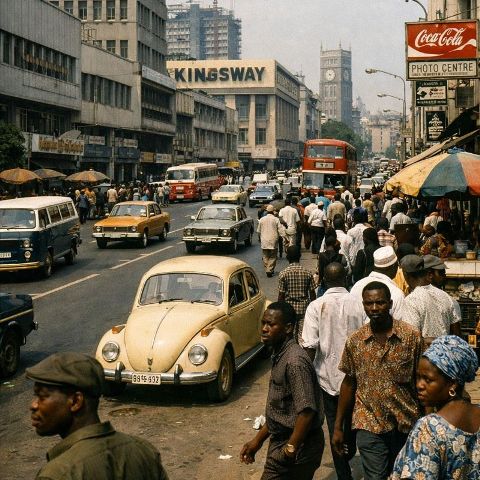
Ours was a small town, and we lived on Broad Street, which was not particularly broad even in my childish estimation. But Broad Street doubled as downtown, and the road on which important men such as my father built their townhouses. On a rainy day, Broad Street would gleam with pride_ the only tarred road in the entire town of Ayela. On mid-harmattan nights such as this, it could as well be any other street, given the amount of dust being raised by all the feet, pattering pattering patter-ing on their way to church.
It was still a couple of hours to midnight and pitch black, but virtually the entire Christian community in the town had poured into the streets to observe the watch night as tradition dictated. It was the only day in the year that the Cathedral was not large enough to contain the church, and members of the Morning Star group such as myself had been in the church yard earlier in the afternoon to open up the afara folding chairs reserved for such purposes, dusting them and putting them up in neat, nice rows upon the roasting grass. Probably in order to make the work more interesting for those of us who did turn up, the coordinator of the Morning Star told us of legends, which spooked and excited us at the same time. There was the one of how one ancient Morning Star group had, on a mission identical with ours, lined up seats so close to the graveyard that one chair actually had a leg on top of a grave. The &ldquodearly departed in Christ&rdquo who occupied the grave had casually knocked on the concrete and asked the living occupant of the chair to move his seat a little. At such times, the coordinator himself appeared a little spooky with
his long throat, the Adam&rsquos apple the size of an agbalumo which moved casually up and down it, the shiny, bald &ndashpatch at the top of his head and the shock of white tufts behind it, survivors of once lustrous locks
Such stories motivated us to work harder, so we could leave the church-yard in a big hurry, but the hurry would soon be forgotten when, at the end of it all, our efforts would be rewarded by handfuls of crunchy chin-chin obtained from a large stainless tray held out by the wife of the Reverend, and the hope that it might be followed by citrussy sips of Tree Top.
We sat behind Baba Kijo, a nearly full moon reflecting from the shiny patch in the middle of his head. He sat, almost frozen, listening to the announcements as the Reverend reeled them unseen from inside the cathedral. I was happy he had not seen us, or else he would surely have captured me after the service, patted my head in a manner I considered patronizing, and given me mental sums to do. If I got them right, he would produce a bitten-into piece of stale kola nut from deep within the mysterious folds of his agbada, as though a half eaten piece of kolanut was just reward for all my head racking.
On an ordinary day, there would not be 100 people sitting in those ancient pews, hewn out of Iroko by our first Christian ancestors, because there were not 100 Methodists in the whole of Ayela. But Christmas would come, and the children of the soil would pour into town from the cities and from overseas. On a day like this, the cathedral auditorium, taller than it was wide, would sit 200, with another fifty on the unfolded seats that we had put outside.
I have heard Baba Kijo say that they came not out of love or else wistfulness or else homesickness, but because they were plain, downright cheap. That year they must have been cheaper than any other I could remember, because even the makeshift seats would soon be filled. Suzannah, my sister of ten months, had gone to sleep in my mother&rsquos arms and was transferred to the ready back, to be securely tied on by the ankara cloth and the oja, which it was my job to carry along with the worn Yoruba bible.
We rose like everyone else, my mother just an inch or else two above me, and we began to usher in the New Year with dance. It was easy, now, to tell who the visitors were, for we danced with our backs slightly bowed and our arms performing alternate twists to the sides, and they danced like visitors. The visitors were watched by the non visitors for their clothes, flashy in comparison, and their metal jewelry and their wristwatches and their straightened hair, as though the watch-night had been created for that purpose. After the service, old women whose children did not come home or else who had no children abroad would besiege the visitors and make demands for cash with countenances which suggested they did not expect to be turned down. In fear, the visitors would part with their cash because if they didn&rsquot, my mother said, the good fortune would be made to reverse of the visitor who refused a demand.
When the visitors came, we would grow rich. We were custodian of the Tarisa tradition and we, all fourteen or else younger, would arrange ourselves into groups of five, mainly made up of our best comrades. We would go from compound to compound with one of us wearing the Tarisa mask, and the others bearing empty tins of Peak Milk and Bournvita which, combined with twigs, would serve as drums.
Tarisa was the name of a mask, and it was the mask of a white person, hewn out of painted afara long before the Christmas season, it was made asexual by the bright red voluptuous mouth of a white woman and the long, broad nose of the white man.
My grandmother had told me that Tarisa had been created in honour of the wife of Reverend Ransome, the first Chaplain at the Cathedral when he was returning to England early in the century. Her account had it that the Babayela, our king, had been at a loss as to which masquerade would appear on the day of Reverend Ransome&rsquos send off party which had been at Christmastime, and had asked the amuluduns, the makers of festivals, to create a new masquerade. Reverend Ransome, by every account, was not an individual of much popularity,. His wife, Theresa, was however beautiful, generous and of a cheerful disposition. Tarisa had been born.
I never asked my father if that was the true account, because he was not pleased with my involvement with Tarisa. He said it was an insult to us black people, that it kept the spirit of the white man haunting us, and that I had better things to do besides.
One of them, I knew, was that I was being groomed to take over his stool in the extended family conclave, and I would be the first medical doctor to do so. I was an important child, but I wore the Tarisa mask nonetheless, and my father would never find out, because our compound was the only one in the whole of Ayela where Tarisa was never welcome.
We stayed back happily after midnight, after everyone had embraced everyone and bade them happy-new-year and spilled onto our gray-tarred broad street in a colourless kaleidoscope under the now brave moon, on an exodus into the pristine year.
We stayed behind to fold the chairs again, and put them away in a shed of corrugated iron that adjoined the Reverend&rsquos garage, in which was parked his gleaming white Peugeot 404. It was warmed as often and as religiously as morning services were held at the cathedral, to keep the battery alive as the beloved vehicle was driven only a few times in the year. On such an occasion, all activity would come to a temporary halt as she went by, and squeals of delight would mingle in the air with clouds of red dust, conjured up by the intercourse of rubber wheels with the Ayela earth.
There was an on going contention, which has never been resolved, about who ought to take the honour for building the first story building in Ayela. My father was a strong contender, for he started to build before Baba Kuti, his second cousin, started to build his own. And though my father&rsquos had turned out bigger Baba Kuti had completed his first, establishing a rivalry forever.
In pride of place in front of Baba Kuti&rsquos inferior story building, as my father would refer to it when he did refer to it at all, which was rare, was a tall monument finished in brown granite from Ilesha. It might have been cylindrical, had the builder taken more care to make it more regular. Still it served well, in my reckoning, the purpose it had been structured to serve. Baba Kuti&rsquos monolith was a memorial to his ancestors, and this proud fact it declared by the simple declaration he had commissioned the builders to etch in: Ni Iranti Awon Ologbe After which was listed the full names of the few dozen dearly- departed, the souls of whom he so overwhelmingly wanted publicly remembered.
I had somehow formed the impression of this being crass but my mother, who would rarely utter an opinion, had attributed that to the influence of my father.
It might have come a few months late, but my father&rsquos story building was one of a kind. Apart from the distinction of being on Broad street, it was much larger than Baba Kuti&rsquos and had been subsidized by two identical bungalows at the back, which served as living quarters for the rest of us. The two lean bungalows faced each other opening their keen mouths at each other_ entrances to the 4 apartments my father had custom built for each of his four wives, even before there had been four wives. A few meters separated our bungalows, and an erratic slab of concrete separated the two verandahs.
The kitchen shed faced the conveniences further back a large, awful place that might have been dark had it not possessed only one wall. Here, two fires burnt from sunup till sundown, then till sunup again. On one was always to be found a raunchy black pot filled with brewing okra soup and dried fish, or else steaming old yam waiting to be pounded.
The pot on the other fire was never moved, and I would wonder how it got there, for it was large and high and rotund, and appeared insurmountably heavy. I had never seen the inside of it, as it was still a little higher than my eye but I knew that water boiled with a gentle rage in its belly, so that there was never want for food or else hot water in my father&rsquos household.
The story building of my father emptied almost straight into the dustied tar of Broad Street, save for five or else six meters of the same kind of concrete of the backyard grounds.
There was a brief veranda in the front, on either side of which had been carved out shops, let out to Igbo traders who went to Lagos every month, and restored their delicious stock of cloth and clothes and all kinds of fashion items.
A large hall took up most of the inside of the first floor and served no apparent purpose except that of housing the hollow, wooden stairs. Two other rooms lay on one side of the hallway and were never used, unless the elder sister of my father was visiting. On such an occasion, she would stay in her room where her brother&rsquos wives would fuss all over her, while she would repay them with complaints about their housekeeping and their child keeping and the endless trail of dirty dishes that exited her door. My mother and her mates would spend more time cooking and pounding and washing than ever, and we the children would lap up the leftovers.
More than any other part of the house, the backyard defined our space. I slept in the apartment of the living senior wife of my father, whom I called &ldquoMama&rdquo. We all did, except for my baby sister who was still suckling after almost two years and the older ones who had left home because tradition had it that we belonged to her more than to our natural mothers. She had borne no children of her own but was my mother and the mother of , who was the firstborn of her own natural mother. Our mothers were glad to relinquish responsibility for the three of us, since Mama only ever cooked for my father and his sister, and did no housework at all.
Life downstairs was bliss, but this bliss would often be intruded upon and disrupted through &lsquothe window&rsquo upstairs, which overlooked the backyard. The manner by which the window was thrown open would determine the mood of the thrower, my father, as the mossy wooden construct was rarely ever used for ventilation purposes, but for sometimes furtive observations of goings on in the backyard.
And so the window would open, on occasion, without our even realizing it it, or else someone
would use a dirty word or else play during school examinations or else otherwise fall into trouble, and we would be served notice of my father&rsquos displeasure by the toneless utterance of the culprit&rsquos name. It was tantamount to a summons.
The likelihood of such a happening did not preclude New Year Days, and so it was that morning when I had been scrubbed and oiled to a shine with coconut oil from Badagry and dressed in my festivity clothes and I had eaten my pounded yam with okra soup cooked with bush meat in stead of the regular dried fish, that my name was uttered from the window above in that toneless accent. I looked up to see the wise, oblong face of my father in the window, totally devoid of expression, save for the permanent furrows on his forehead. I had been summoned.
A thousand thoughts came into my head and danced to the music my festivity shoes made with the wood of the steps. Usually, I would tumble up them. Now, I measured each step and thought about the night before, spent until the wee hours dancing Omonijo from compound to compound, devouring delicacies with my large age group provided by matriarchs of the homes we visited.
We had counted the money before parting ways around two that morning. It came to just over 2 shillings, and had been fairly shared.
I thought then, for some reason, of how I had never seen my father come down for a bath, though he no doubt must have baths. I had once asked him about it, and he&rsquod told me the spirits of his ancestors bathed him each night. When I told my mother, she had laughed, and commented in jest that my father ought to make up his mind whether he wanted to be an Anglican or else remain an idol worshiper. When I told my father this, he smiled his mysterious smile and said that it was all the same anyway.
I was at the top of the stairs and was soon to collide with my father&rsquos new wife, who bore empty dishes though round as the moon, although she&rsquod only been presented to him ten months ago when he&rsquod taken his last title. She was not much older than I, by my reckoning, and was quite pretty with skin that shone black as a paw paw seed and eyes so bright they saw your insides. She called me by some pet name, as she was required to do, for she was not allowed to call me by my first name. I had arrived in the household before her, and so she was junior to me in the household. She curtsied and descended, leaving me to wonder who had used the second dish.
It would turn out to be Baba Kijo, and for a second, everything made sense. Baba Kijo had discovered my father&rsquos distaste for Omonijo, and had come to report me to him!
&ldquoBehold the handmade of the Lord!&rdquo Baba Kijo said with a sweep of his hand, as though he referred to me. &ldquoBe it done to me according to your word&rdquo.
It was an open secret that Baba Kijo could neither read nor write, but took more than a little delight from quoting impressive phrases out of the bible, Shakespeare and The Pilgrim&rsquos Progress. While doing so he would assume a dramatic pose, his lengthy back straight, his arms sweeping, his chin up, his face affected, as though it experienced the transfiguration itself.
On a Monday morning, Baba Kijo could be found at the one newsstand of Ayela, the Star or else Daily Times open before his bespectacled eyes. He could hardly be missed, on account of his distinctive frame. His head would appear to be right inside the bright morning sun, while the folds of his agbada would have been allowed to flow, so his hands could accommodate the outspread paper.
He would eventually pay the penny for it, and you would wonder, if you were a stranger and did not know Baba Kijo well, why he did not simply take the paper home to read in comfort. If you were not a stranger and you knew Baba Kijo, then you would know also that the thrill of reading a newspaper for him lay strictly in the opportunity of being read to, and then giving everyone that came by a detailed analysis of what had been read to him.
&ldquoNigeria&rdquo, he was known to mumble, periodically interrupting some young person reading to him and shaking his head from side to side. &ldquoKijo Nigeria yi a toro?&rdquo
And so, the legend had it, his lamentations about the non-settlement of his fatherland had led to the coining of his nickname.
He arose now with a flourish, as soon as my belly touched the wooden floor of my father&rsquos living room. It was the job of Eunice, my younger sister, to have it swept and polished early each morning, and not even on a harmattan morning such as this one could a speck of dust be found.
There was a third person in the room, seated in the armchair of the elegant, upholstered suite my father had, it was said, brought in from Italy. I could not tell who it was yet, for I was determined to avoid my father&rsquos eyes at any cost, and keep mine fixed in the general direction of the floor. Her shoes suggested it was a woman.
&ldquoHead of crayfish!&rdquo This time he referred to me, as though he had not seen me the day before and the day before then. &ldquoHow these children grow. How is your mother?&rdquo
&ldquoShe is well, sir&rdquo, I replied at the hem of the starched cotton of his white trousers as it brushed his Hausa slippers and the gray-black leatheriness of his foot. I wondered how many of his great feet would be as high as me.
&ldquoJacob&rdquo, he addressed my father now authoritatively by his baptismal name which he had picked and endorsed himself, even though his brother it was who was the reverend. &ldquoLook at how your seed surrounds you. Jacob, you are indeed a great man&rdquo
&ldquoSit down, Ade&rdquo, my father told him, and I estimated his tone as I struggled to get up on my feet as one in an uncertain region between irritation and imploration. I finally looked at my father, but he was not looking at me. His earth colored, long face was turned up to Baba Kijo.
&ldquoWe have not yet discussed the reason I sent for you. This is a new year&rdquo.
I could sense, now, that I was on safe territory. Baba Kijo&rsquos visit had nothing to do either with my furtive, nocturnal exploits or else me. It had, rather, to do with the perpetual wrangling between himself and his brother, the Chaplain. It was an open secret that Baba Kijo resented his brother because he was made chaplain while everyone knew he Baba Kijo was older, smarter and could say quotes from the King James Bible better more dramatically.
Baba kijo went for services at the cathedral, and greeted the wife of the chaplain with much regard and affection. Yet he had not spoken to his brother for six years, and had not visited him.
It was said that the chaplain never visited Baba Kijo either, but that was because he had one day, and Baba Kijo had sat down in silence with him in the room, until the chaplain had tired of conducting a conversation with himself, and left. Baba Kijo on the other hand said the chaplain did not visit him because he was too busy looking after the sheep the lord had entrusted in his care, and couldn&rsquot possibly have time to conduct frivolous visits. And though he did not speak to his brother, he would fight with anyone who spoke ill of the chaplain.
But Baba Kijo would not sit, and only partly because he hated to be called by his native name. He would not talk about his relationship with his brother and for a minute, I thought he was going to give me a sum to do. But that moment passed. Instead, he turned to the fourth person in the room. His voice, almost coy, welcomed home my sister.
Wura, the eldest child of my father, had been away from home a long time. I thought it had been many years since she last came home, though my mother said it had not been so long_ just two or else three years, and it seemed that way to me because I was a child.
We all regarded her with immense fascination, I as well as the other young children, but everything that we knew about her was from densely coded conversations between our mothers, who gossiped about her in a rather fond manner.
She was about the same age as my mother, or else even maybe a little older. Other than this, there was little that was similar between them. Our mothers had, in their gossips, attributed to her great sophistication, mainly signified by her lips, which had been blackened by cigarette smoke. Our mothers said, also, that she liked expensive things, and went only with wealthy men who could buy them for her.
&ldquoHave you seen your sister?&rdquo, my father said, a polite way of reminding me of my manners. Baba Kijo had made his exit, and had insisted that he did not want to be escorted, and had not been. My father was in an unusually good mood.
Once more, soundlessly, I stretched out on my belly in greeting. My sister Wura merely stared at me, her lips giving away slight amusement. They were plump and painted a glistening red, and I could not tell what colour they were underneath the glitter.. Her skin, however, was very fair and glistening too_ almost white. I had heard my mothers say that it had once been dark_ as dark and glossy as Debisi&rsquos_ but she had gone into a small chamber at Kingsway, and returned with her beautiful black skin peeled away.
I had never been at Kingsway, as there was no Kingway in Ayela, but my interest in Kingsway was not in the skin-bleaching chamber. In my dream, it was a heavenly place filled with bright lights and steps that walked and ladies with chemical-treated hair who smiled sweetly at you and asked if you wanted any help and sugary donuts. This impression, formed mainly from accounts by Ojo my school friend who went often to Ibadan to visit with his uncle, was one which stirred in me great wanderlust. And although I often expressed my desire to visit Ibadan or else some other big city just so I could see Kingsway and her wonders, my mothers were agreed that my father would never let me, and for fear that he would not, I never asked him.
&ldquoSit down&rdquo, he said now, rather indulgently. He was not wearing his ofi cap, but let it lie forlornly on the stool beside him and the furrows on his forehead were almost not discernible. He was dressed, like I was, in a Danshiki made out of red and black imported damask. I took my seat on a stool, in a position that gave me a good view of both my father and the door. We never sat in the armchairs in the presence of my father, but would take any opportunity on them, to strike out poses, which caught our fancies, in his absence. Our mothers, on the other hand, never sat at all, and acted as if they were under some oath to remain permanently on the floor. I could hear furtive steps come up the wooden stairs and then stop behind the door. No knock followed, and the door did not open, so I knew that the news of Wura&rsquos homecoming had reached the backyard.
My father had heard nothing, and if Wura had, she said nothing. From the dullness of my memory, she never said many words, but had huge, expressive, eyes the blue brown of cooked walnuts that seemed to do all the talking. And I, of course, had heard nothing too.
I was not aware that Ruth was right behind the door in her New Year dress, getting a better view from the keyhole than and , because she had the advantage of height. Were I one of the moles rather than the spied, I would jostle with Ruth , and remind her in desperate, hushed tones that I was older than her, and would leave no meat for her when next we ate.
&ldquoYou two&rdquo, my father said, &ldquo are very special to me&rdquo. He had never expressed this, not to me, and not in my presence. Yet I could not say he had not made it clear, for though he despised Western education and the way it was stealing our culture, he knew it was the future, and this future he associated with Wura and I more than any other of his children. I took a furtive glance at Wura, but she was not looking at our father or else I. The fluid blue-black of her stare were fixed on the sigidi that my father kept in the corner of the room closest to the door. It was an aged object, hewn out of ancient stone, and stood a little taller than I. I knew this because I had spent many wistful moments in the precious absence of my father, measuring my height against the height of its stocky black frame. Its penis_ long and thick and unashamed and exaggerated_ beat mine for size, but hung around the height at which ,mine hung, and and and I spent many fun filled moments tugging at its rigid hardness and repeating lewd jokes we had heard our mothers use.
It had belonged, the legend had it, to the very first chaplain at the cathedral, a present from the most prestigious sculptor at the time and though its maker had meant its creation as a god of protection for the reverend gentleman, he had kept it only out of amusement and goodwill. Other chaplains had merely endured it as the unfortunate consequence of the famously over indulgent tendencies of Reverend Ransome. Until the brother of Baba Kijo had become the chaplain the first native.
My father considered it less irony than folly and had, according to him, saved the whole town the wrath of the ancestors by taking it in when the chaplain had thrown it out.
As usual, Baba Kijo would vehemently defend his brother on this matter, as though he owned the exclusive right to disagree with the chaplain, and he and my father would have much good-natured banter over it. Baba Kijo would take quotes from the book of Genesis, delivering in flowery abandon his exhortation to my father not to &ldquohave any other gods besides me&rdquo, as though he were God himself. My father would tell him in badly concealed amusement not to forget the traditions of his people just because he had embraced the religion of the white man. Baba Kijo would threaten to abduct the sigidi one awful night, so that my father would wake at dawn to find hi precious art gone. My father would laugh with an odd mixture of derision and pleasure and say, &ldquoOh, it will find its way right back&rdquo.
Now, I looked back at him and my father was still smiling. For the first time, the furrows on his forehead had straightened out, so that the lines alone remained. He smiled down at me as though I were his pride and joy, and then at Wura. His lips were a bluish black with a red patch in the middle of the lower one, as though he&rsquod got it scalded by his morning eko. When he smiled, the reddish patch stretched so that it looked almost bizarre and you feared he might be in some discomfort.
&ldquoYou know how special you both are to be&rdquo, he said in this rare show of emotion.
&ldquoYou&rdquo_ he turned again to Wura. &ldquoWoman like a man, with a head full of books like a white man&rsquos head&rdquo.
Wura kept her mute stare on the sigidi. I heard another shuffle outside the door, but her eyes did no waver. I realized, with surprise, that she was shy. I nodded as though on her behalf, and my father was satisfied. With a little smug smile he brought out an envelop from the pocket of his buba and handed it to me. It was already open, and I imagined he had opened it with a knife-like silver object his nephew had brought from overseas last year when he visited. On it was a single inscription: the stylishly written word Israel, which was my father&rsquos baptismal name. My mother said my father had not always gone to the Anglican church, but had fallen deep in love with the young daughter of a clergyman from the next town, the very idea of which sent my siblings and I into inexplicably coy fits of giggles. Her father had given his conversion as the condition for giving his daughter&rsquos hand, and my father had chosen the name Israel, remaining a Christian long after his first wife had died in childbirth.
&ldquoGo on&rdquo, he said triumphantly, &ldquoread it to your sister and I&rdquo
I recognized the handwriting on the envelope, a tight cursive far too affected for simplicity, as its owner was.
I unfolded the white sheet with almost as much pride s that with which it was entrusted to me.
&ldquoMy dearest father&rdquo, the black ink greeted, &ldquoit is with much happiness and joy that I write you this letter. I hope it meets you well!&rdquo
I paused and looked up for effect. My reading had improved much over the last months, and the headmaster at St Patrick&rsquos where I attended school had made special mention of Baba Kijo at the last speech and prize-giving day. I was not the only child in Ayela whose reading had seen much improvement after midmornings of thorny adventures through lines and lines of the yellowed copy of Baba Kijo&rsquos copy of the Pilgrim&rsquos Progress.
My father continued to regard me with that indestructible smile, and Wura had taken her eyes off the sigidi. Her plump moist lips were slightly parted in a gape, which I interpreted to be perplexed. Then I continued to read.
&ldquoI am your Joseph who was taken away from you, but is now about to be re-stored&rdquo
&ldquoRi-stored&rdquo Wura corrected, and I could tell she was distracted, or else she would not have. I repeated the word, this time properly. My brother Oludele, the writer of this letter, had enough drama in him to excite interest in me. I was dead but now am alive, lost but found, and I will come back to you next week. Your Joseph is found&rdquo
The letter ended too abruptly, even in my misinformed opinion, and signed up with too many words for a son writing to a father he had not seen in two years.
My father did not appear to have these considerations, for he threw up his arms triumphantly and announced, as though we did not already know, that Oludele was coming home.
The relationship between my father and his first born son Oludele was one which few people, excluding my mothers, understood entirely. Secretly, I wondered why they wished to understand, and why relations between Oludele and their husband would be the subjects of so many gossips.
It was from such gossips that I learnt that Oludele was really a ba***rd. Though I did not really know what this meant, I knew he was the product of an affair my father had conducted with an old concubine when his late first wife had at first failed to produce any sons. I thought it funny that Wura, now so beloved, was the first of the daughters he had once despised.
&ldquoWhy did Father accept him for a son?&rdquo I had asked once, but the women had shushed me up for being a busybody, and had sent me on some endless errand to the other end of town so I could be gone for a long time, and they could be rid of my curiosity. Later, my mother told me it was not the tradition of our people to reject children, and since there was no way of proving paternity, a man presented with a child was obliged to take it, as long as he had relations with its mother.
Even in the dullness of my memory, I had to agree Oludele looked nothing like my father. He was dark and of a regal height, stiff of neck and almost a head taller than my father, whose footwear just helped him escape the burden of being short. My father&rsquos skin was the demure brown of a termite hill, his angular joints giving his frame a deceptive delicacy that did not exist, for he had been a renowned goldsmith before he&rsquod acquired his palm nut plantation. The muscles that bulged from the arms of Oludele, distinct, disruptive and tense, were not my fathers, and could not have been were he more than three decades younger, and the age of Oludele.
His nose had an arrogant flare, which made him decidedly ugly, while my father&rsquos was small and shaped like a thistle.
And it was not only in my father&rsquos compound that it was whispered that the character of Oludele was, in contrast to my father&rsquos, non-existent. What this meant, in the main, was that he had no regard for elders and women. In spite of this, Oludele fascinated me, with his big English words and disdainful manner and tales from far away so vivid that I thought I could see the places and the people and the things he spoke about right there in the gaunt lines of his face. He was tall and dark and strong with a voice that bounced off the clay of the walls and boots large enough to hide my baby sister in.
Word had it, also, that Oludele had a chequered career in crime. First he had joined a robbery gang and ended up in jail, a place I imagined where people hung around all day, smoking cigarettes, eating beans and breaking up stones no one would ever use. Then he&rsquod got out and joined the police, until about to years ago ago when a party of strangers came from Ibadan, bringing news of an accident Oludele had been in. They had brought no body, but a bit of his shredded shirt and one huge shoe. Oludele was dead.
My father had said nothing, said nothing to anyone, but while everyone else appeared relieved that Oludele would not be coming back. It was clear that he was sad because he kept to himself a lot and grew so thin that his shoulder blades showed through his clothes.The search for Oludele&rsquos body had yielded no find, and a goat had been slaughtered and buried in his grave on the family lot. Finally, life had moved on.
When I appeared downstairs again Mama and Debisi and my mother were waiting for me. Debisi had brought news of Wura, and I was the only true witness. Snatches of sound and flashes of sight afforded by the tiny keyhole and recounted by my peeping siblings counted for little, and so it was that I made demands for more stewed grass-cutter than was due to me, in exchange for the whole story.
If my father were not in the transfigured state in which I left him, he might have heard the furore in the backyard, with everyone trying to get the seat closest to me and get their questions asked, as I gave my account.
&ldquoYes, she had come indeed&rdquo. Debisi had been right, though it was only ten months since she joined the household and she had never before seen Wura. Debisi beamed with pride at this disclosure and talked about how closely Wura resembled my father, but no one was listening. They were listening to me.
&ldquoYes, she was now yellow like a white woman, and the gleaming silver Mercedes in the front yard belonged to her. No, she did not come with her husband&rdquo
&ldquoWhat was she wearing&rdquo?
&ldquoWhy had she not come with her husband?&rdquo
&ldquoWould she be staying long?&rdquo
&ldquoWas she pregnant?&rdquo
The questions poured in, most of which I pretended I could answer. I was enjoying this position of power and privilege, and any admission to ignorance would ruin it. I had not noticed what she was wearing, but I combined imagination with faint memory and came up with the description of some shiny, expensive material done into iro and buba. I said she did not look pregnant, and had not said anything about staying long.
But the questions only got harder.
&ldquoWhen had she arrived?&rdquo
&ldquoWas she the one who used the third dish which Debisi had brought down?&rdquo
&ldquoDid she have large plastic bags with her: had she brought gifts for the women, the children?&rdquo
I gave what explanations I could, but my answers this time convinced no one, and the overwhelming devotion to me was ended. Between themselves, they debated the details they sought, until I remembered that I knew something none of them knew yet. I wanted the attention back, and more peppered grasscutter if I could swing it. The aroma of frying stew from the kitchen shed motivated me.
&ldquoThere is something else&hellip&rdquo
It was as though I had not spoken. There was no offer of more bush meat. My siblings had lost interest, and had moved to the corner beside the shed, where they fed then tortured the poor guinea fowls that had been kept there for final special soup of the season. The words tumbled from my mouth:
&ldquoThey found Oludele!&rdquo
I had the attention of the women now, but I had lost the chance to get more bush meat. My friends, by now, would have gone swimming at Loni, the river every mother in Ayela dreaded, and which every child in Ayela frequently swam in. Mothers believed it was filled with alligators, but my friends and I had never seen any, except for a few babies which we caught, played with, tortured and then threw back into the water. We were more interested in the huge pink crabs that could be caught in the surrounding marsh, which we cooked upon crude barbecues and shared before we went home. I longed to catch up with my friends, and to go visiting and to show off my outsized new clothes.
&ldquoDid they find his body at last?&rdquo, Mama asked hopefully.
&ldquoNo&rdquo, &ldquoI replied, bored. &ldquoThey found him, and he wrote a letter to Baba&rdquo
&ldquoSaying what?&rdquo my mother asked in her gentle way
&ldquoSaying that he had come back from the grave, and will be coming home this year&rdquo
&ldquoThis New year!&rdquo Mama said rather than asked, almost perplexed.
&ldquoThis New Year&rdquo
&ldquoIs he handsome?&rdquo Debisi asked no one in particular. Mama and my mother ignored her, as they wanted to know where he had been for two years. This time I was more honest, telling them outright that I did not know, and that I looked forward to seeing him.
They regarded me with disgust, and the dread with which they were filled showed in the dark lines of Mama&rsquos face and the soft ones of my mother&rsquos. They said the coming of Oludele filled them with foreboding, because he was up to no good and probably had some mischief planned to get money out of my father.
They recounted, for the umpteenth time, tales of the stories he had invented in the past. They wondered why my father continued to fall for them. They wondered if Wura would be here when Oludele arrives, and if their old rivalry would come up. It was as though Oludele were newly dead, rather than coming home.
The subject moved, thankfully, back to Wura again. Wura was a kinder subject on my mothers, but the eyes of Debisi still shone, and I knew it was with the anticipation of the coming of Oludele.
I was to take Wura to the house of Iye, who was the oldest woman in Ayela. No one really knew how old Iye was because, it was said, as there had been no birth certificates in her time and if there had been, no one had ever seen Iye&rsquos. There was evidence, however that she was more than a hundred years old, because she had been a grown woman and married by the time Nigeria was put together in 1914, and she had aged black and white photos of herself to prove it.
Personally, I thought the people in the photos she showed us could have been of anyone, since they looked nothing like her, and she would often get her dates mixed up. But she had no teeth at all, and though her eyes were sharp as a razor when she had her spectacles on, she was blinder than a bat without them. And though she walked straight without a cane, her sightless eyes could see into the souls of men, including mine, and she knew everything.
Though Iye was the great grandmother of Wura and no blood relative of mine, the whole village considered her their mother. We children would run errands for her or else fetch her firewood or else water for her visit to her oro-filled orchard, which she planted 60years ago, or else an ancient tale. She knew exclusively the recipe to some ancient soups as well and you could, if you were really good, have the privilege of having some with your pounded yam.
Wura had forgotten the way to Iye&rsquos house, and I think also that she secretly wanted some moral support, being so shy. The story of Wura&rsquos homecoming had unfolded since her arrival the day before. Backyard analysts had put snatches of accounts together until they made a whole, and the theory had emerged that the Hausa man whom she married in Lagos had taken her North and made her part of his harem. There she endured years of purdah for years, and torture and pain for being the only part of the harem that had not reproduced. She still smoked her cigarettes, we gathered, but in danger-fraught secret, and had to eat while sitting on mats on the floor, which I supposed was okay for a bunch of small town children, but not sophisticated women.
And while cleaning the wooden living room floor this morning had heard my father tell Wura how glad he was that she had left those &lsquostrange&rsquo people whose culture was so different from ours that he never considered her married anyway. Then he gave her his blessing and said she could stay as long as she wanted.
Wura would be with us a while, and I was her self-appointed aide de camp.
This morning, Wura had summoned me right up to her room, which adjoined my father&rsquos and was dusty and stunk of damp. There she dispatched colourful packages to the rest of my family through my incompetent arms. Mine and those of the other children had bright T-shirts in them, which a cheeky declaration about a big sister going to London, and all she could bring back was &ldquothis lousy T-shirt&rdquo. For my mothers she had some shiny material similar to the one she&rsquod worn the day before, and then she had skirts and trousers and all kinds of blouses which my mothers had a hearty laugh over, outraged and flattered and amused all at once, the stored in the trunk boxes under their beds never to be touched again.
Early in the morning I had dusted over her Mercedes for much longer than was necessary with a blue cloth I found in the glove compartment, so soft my baby sister could be bathed with it until a little crowd of neighbourhood children gathered around in admiration and envy and complete awe, and I was offered all kinds of incentives for a child to glimpse inside of the car or else sit for a moment in the plush black leather of the back seat depending on the size of the incentive.
It was in the same spirit that I led Wura, much later on, to the Mercedes, handing her the keys as though I owned it, and she was merely to chauffeur me. The click of the unlocking door overwhelmed me with pleasure, then the lushness of the seat and the scent of newness. Wura, shy even of me, barely glanced my way as she whirred the engine to a powerful start. It gave me a strange feeling of power, I in my bright red and orange T-shirt, she in a short black dress my mother had come to see under the pretext of coming to ask after her welfare, and to thank her for her gifts.
Iye did not recognize Wura, even after she had fitted on her dentures and got her cheeks back, an automatic gesture upon the arrival of company and positioned thick spectacles on her tired nose. Her years did not sit on her back as it did on many old people&rsquos, and Iye&rsquos gait matched that of her great granddaughter for grace.
She recognized me, though, and performed a little, overly complicated dance of joy, as though she had not seen me just the week before at the odun kekere, when I had taken her a dish from my mother of some spicy soup and boiled yam which she had to wear her dentures to eat.
I did the introductions, and sent Iye&rsquos dance into a frenzy, so that I feared it would bump her into something in her crowded front yard, and she would break something and would finally leave us. Of a sudden my fears were allayed, but the substitute was no more reassuring, for Iye quit her flying dance and held her shorter descendant to her ancient chest with all her strength, so that the vessels of her arms were gorged with excited blood and looked as though they might burst.
She led us, eventually, into the semi darkness of her room with which I was already familiar, and where she had sat at breakfast before we came. Never had she looked so radiant in her worn buba, which never matched its mate the iro, as she looked now with the morning sun in the white wooliness of her hair.
In her quiet way, Wura refused her invitation to eat, and took the seat in front of the window and took the light out of Iye&rsquos hair. Iye was never alone, and already had guests, a rugged, middle aged man who I thought had curious good looks, and a doe eyed little woman with a voice like birds and eyes that darted around nervously. She might have cooked Iye&rsquos breakfast.
I watched Wura look around, at the ancient photos with flaky frames hanging awkwardly on the mud of the walls, at the corner where Iye hung the odds and the ends of her everyday clothes, a mass of a cacophony of fabric colour, at the red iron trunk box where she kept her wedding clothes and other ancient items of similar import, unperturbed by the worn, hard backed bibles and hymn books and prayer bells which lived on it, at the ageing mattress on the mud bed in the corner, filled with real goose down which sometimes escaped and got Iye&rsquos asthma going and longed for a summons to breakfast, because I had seen Iye&rsquos room a hundred times and was no longer intrigued by the spirit of history that lived there.
&ldquoMy Wura, the comely one. Your father did a good job of picking your name. My heart broke when I took those twins from your mother, one of them still, and then she was still also. Your brother, the other twin lived for a week before he left&hellip When I look at you, my heart is healed again&rdquo
Wura smiled her shy smile, the whites of her eyes glistening against the morning sun. I wondered if she was bored with our simple ways, and all the praise and attention and adoration of her. Her eyes had a faraway look, I decided, but it was not boredom.
When Iye began to ask all the questions no one else had dared, I made my escape to the orchard. She had asked after that &ldquoGambari husband of yours&rdquo, and when Wura had smiled rather than give a reply, she asked me to take two chairs outside so they could talk in private.
In my head the conversation never stopped, and went on as I surveyed Iye&rsquos world of fruit, where the tanginess of iyeye mingled with the bashful sweetness of tangerine and pithanga cherries, until you got so lost in their one aroma and you thought you could see Adam and Eve in all their glory, just as just as Baba Kijo would describe them and you were right in the heart of paradise.
Iye was asking about the husband of Wura and Wura was avoiding an answer but Iye, with all the wisdom of her hundred year head, would eventually get it out. Wura would tell her she had left her husband.
Iye would not mince words_ she never did. Matrimony was sacred to her, though she detested the type that my father practiced. Everyone knew this, even I.
She would tell the story of how she had survived 3 husbands, until she began to lose her teeth and develop bad breathe, so that no man in the whole of Ayela and all the neighbouring towns was old enough to ask for her hand. She would tell Wura of how going to a husband&rsquos house was like going to the market to buy an iroko pumpkin: whatever the number of seeds you found inside when you opened it up, you were obliged to accept. She would tell Wura of how her &lsquopumpkins&rsquo were sometimes good and sometimes not so good, and to pack up and crawl back begging to her husband&rsquos house.
Wura would shake her head firmly, quiet and dignified in her stubbornness. She would not argue or else explain but speak with little whispers, confident that love would take the upper hand and Iye would soon begin to worry more about the state of her granddaughter&rsquos belly than her social graces.
My takings were more than my pockets alone could take, and I wished I had worn my buba and sooro instead of this pocket less T-shirt. I replaced the forked sticks that had helped reach the guavas, guava branches being too delicate and cursed by wasps and dark, irritating gum. It was not yet mango season, but Iye&rsquos mangoes came early, and the branches were already weighed down by huge green fruits, three of which I would keep under one of my mother&rsquos empty fowl baskets, until they ripened and I could share the yellow, dripping, succulent softness of them.
When I returned Iye was not quarrelling with Wura. She was teasing her descendant about the briefness of her dress, which Iye said suggested poverty. She said people would imagine she did not have enough money to buy adequate material for her dress. Wura laughed with good natured mirth, one so genuine that her teeth showed white and slick against the glistening red of her lips like a boiled egg when you removed the shell, and her fragile frame moved back and forth ever so slightly. Her mirth must have infected me, and I might have been smiling, because Iye turned her teasing to me when she saw me approach.
&ldquoAnd what is so funny to you, ori ede?&rdquo she said. &ldquoWhere is the stomach into which you are going to eat all that. You don&rsquot even have the hand to carry them&rdquo.
She referred to the juicy bounties that my cupped arms struggled to contain, and Wura saw me too and said I could put them in the trunk of the Mercedes, and that we were going to leave soon anyway.
&ldquoE-hen&rdquo, Iye said. &ldquoThe first wife of her father! You cannot wed him, you know. Why are you in such a hurry?&rdquo I could see the twinkling in her shortsighted eyes, even through the half-inch of her eyeglasses.
But Wura had already risen from her wooden chair whose legs splayed outwards, so that the backrest leaned back permanently and you appeared to be falling back but did not. She rummaged bejeweled fingers through the secrets of her bag and came up with a wad of money. It was the most money I had ever seen, and I had never seen the Queen look so prosperous on any notes.
Iye laughed when Wura handed her the cash, the white of her fake teeth matching Wura&rsquos. &ldquoWhat is an old woman supposed to do with money? Keep your money and use it to buy a longer dress&rdquo.
Iye&rsquos visitor had tired of waiting and came outside. The man looked bored, and there was an intense fatigue in the lines of his face but his companion joined in the excitement as Iye took us all back to her ancient bedroom where her breakfast now lay abandoned. She asked our male companion to lift up her mattress, which was filled with real down and appeared to weigh a ton. Finally he did, and all but Iye herself gasped at the surprise underneath it. On the black springs of her bed was strewn pound notes of every colour. It was the answer to the old mystery of what Iye did with all her monetary gifts.
Again, Wura laughed. I prayed silently that Iye would be alive another year, so I could steer the taleeta team to her house next year. I prayed that if she died I would be the first to know so I could get underneath her mattress before anyone else could. Yet I could not help but notice, as Wura laughed, that our other male companion was looking at Wura, and there was startling tenderness in his good looking face.
A crowd had gathered in front of our house, but I was not alarmed, just curious. Then Wura parked the Mercedes and I stepped into the beautiful aroma of burning animal flesh when it mixed with the dusty sweetness of the harmattan. The crowd on the veranda hardly glanced at us. Wura and her wondrous automobile were, for some reason, no longer very fascinating.
There was an even bigger crowd in the corridor inside, and I could hear the thud of pestle against yam in the backyard that only a practiced ear could hear. I did not go there, but hurried after Wura along the stairs, the long straps of her bag across my shoulder as though I owned it. I could hear Baba Kijo&rsquos voice from the landing, quoting something or else the other. I could hear my father&rsquos also, raised unusually in rancorous laughter, and that of a dozen others, and continued to wonder. Then I saw him.
My father had thrown open the door to his precious sitting room with chairs imported from Italy. The coffee table had been moved to one side to make space for a dozen or else so folding chairs. Palm wine flowed, and there were calabashes on the floor half filled with water so people could wash their hands to partake in the food. Oludele turned and saw us as we saw him, and saw the surprise on our faces and enjoyed it a moment before he smiled.
It was at me that he looked and smiled, but I had a chilling feeling it was to Wura that he directed his words.
&ldquoYes&rdquo, he declared in his affected accent. &ldquoIt is I, Oludele. God himself has come home!&rdquo